Storm and Flash Flood Cleanup in Raleigh, NC
Flood water carries soil and contaminants into a house, so it is cleaned differently from a pipe leak. Garner crews extract, remove what cannot be saved and treat and dry the structure for Raleigh homeowners after storms.
(888) 578-4720Request storm flood help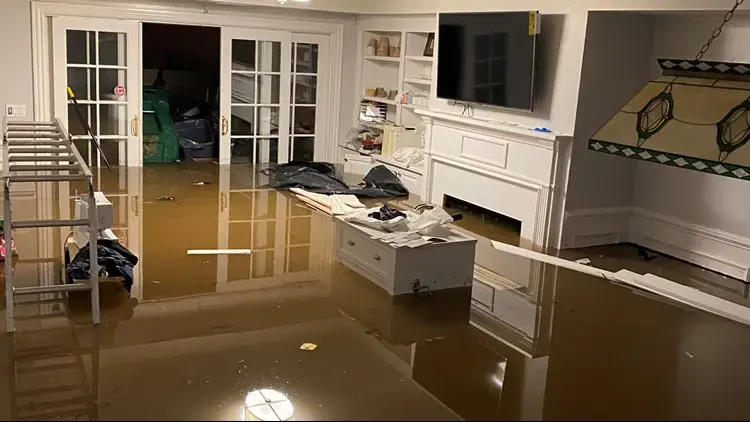
What to do when storm water gets inside in Raleigh
- Stay safe Keep out of standing water until the power is off, since it can carry contaminants and live current.
- Lift valuables Move electronics, papers and keepsakes to higher shelves if the water is still rising slowly.
- Take photos Record the water level and damaged items for the insurer before cleanup begins.
- Call early Ask the crew for extraction and treatment before the pad and drywall soak through.
How storm and flash flood cleanup is handled in Raleigh
Measured before anything is cut
The tech who does the walkthrough maps how far the water traveled into subfloor, baseboard, wall cavities and the crawl space, so the plan fits what is actually wet.
Dried as a whole structure
The drying team sizes air movers and LGR dehumidifiers to the class of loss and dries framing and cavities, not only the surfaces in view.
Logged for the adjuster
The restoration team keeps the moisture map, daily psychrometric readings and timestamped photos taken before any material comes out.
What does storm and flash flood cleanup cost in Raleigh, NC?
Storm flood cleanup in Raleigh begins around $3,000 for a garage or one room and runs to $35,000 or more when most of a house is affected. Crawl space work and multiple rooms usually land between $7,000 and $15,000.
Garage or one room
- Category 3 extraction
- Flood cuts and pad removal
- Antimicrobial and drying
Several rooms and crawl space
- Containment
- Insulation removal under the floor
- Structural drying
Most of the house
- Whole-floor tear-out
- HEPA air scrubbers
- Contents sorting and photos
Ranges are typical, not a quote. Water category, square footage, material class and how fast drying started move the number most; the water damage cost calculator gives a closer planning range.
The storm and flash flood cleanup process in Raleigh, step by step
- 1
Contain
Affected rooms are sealed off and protective gear goes on.
- 2
Extract
Flood water is pumped out and floors are cleaned.
- 3
Remove
Pad, low drywall and insulation that soaked through are cut out.
- 4
Treat and dry
Antimicrobial goes on, then air movers and scrubbers run.
Rain that floods a yard or a garage does not behave like water from a broken pipe. It has crossed ground, drains and parking surfaces on the way in, and porous materials it touches are usually removed instead of dried. Cleanup begins with extraction and protective gear.
Flash flooding and creeks around Raleigh
Tropical Storm Alberto brought flash flooding to the Raleigh area on June 14, 2006. Raleigh has 36 watersheds, each tied to a stream, and in the Walnut Creek watershed hardened surfaces have increased stormwater flows that contribute to flooding. Rain that falls on downtown Raleigh flows into Walnut Creek.
What flood cleanup involves
- Flood water extracted and the area cleaned
- Wet carpet, pad and lower drywall cut out
- Antimicrobial applied to surfaces and framing
- Air scrubbers and dehumidifiers run
Hurricanes Dennis and Floyd in September 1999 helped bring over 21 inches of rain in a single month, a reminder of how much water a season can deliver. Garages, ground floors and crawl spaces are checked first.
Floodplain and flood maps
Raleigh has a Special Flood Hazard Area ordinance that adopts the current FEMA flood maps. Flood claims and rebuilding can depend on those maps, so records and photos matter.
Storm and flash flood cleanup across Raleigh and nearby towns
Storm flood crews work across Raleigh, including South Raleigh and Southeast Raleigh, the Walnut Creek watershed near downtown, and neighborhoods near Lake Johnson, Lake Wheeler and Brier Creek.
The same service nearby: storm and flash flood cleanup in Garner, Knightdale, Cary.
Related water damage services in Raleigh
Storm and Flash Flood Cleanup questions in Raleigh, NC
Why is flood water treated differently?
It crosses soil, drains and pavement before it enters the house, so it carries contaminants. Porous materials are removed and surfaces are treated with antimicrobial, instead of simply being dried.
Does Raleigh have flash flooding?
Yes. Tropical Storm Alberto caused flash flooding in the Raleigh area on June 14, 2006, and hardened surfaces in the Walnut Creek watershed have raised stormwater flows.
Is flood damage covered by regular homeowners insurance?
Often not. Sudden pipe leaks and flood water are treated as different causes, and flood coverage is usually a separate policy, so check with your own insurer before assuming.
Can carpet be saved after a storm flood?
Sometimes, if it is cleaned and dried promptly, but pad is usually thrown out. Carpet that sat in contaminated water for long is normally replaced.
What happens to the furniture and belongings?
Items are photographed, moved to dry areas and sorted into keep, clean and discard piles so the claim has a record.
How is a flooded crawl space handled?
Water is pumped, wet insulation under the floor comes out and joists are dried and metered. See crawl space water removal.
Storm water in the house?
Garner crews pump out flood water, cut out what soaked through and treat the structure, with photos and notes kept for the claim.
- Garner, NC and southern Wake County
- Every hour of every day